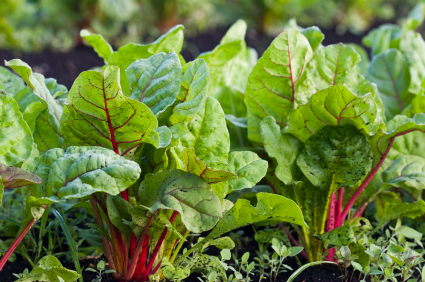
Swiss Chard
 |
 |
 |
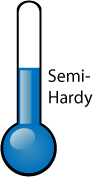
Swiss chard is a semi-hardy vegetable that grow best in cool weather with lots of sun. Unlike many greens, chard will tolerate warmer temperatures without bolting or going to seed.
Spring Planting
Swiss chard can be planted directly in the garden 4 weeks before the frost date.
To harvest swiss chard sooner, start seeds indoors 10 weeks before the frost date, or purchase transplants.
Transplants are ready when they have 4-6 true leaves. Harden off and transplant outside 4 weeks before the frost date.
Fall Planting
Plant seeds directly in the garden 11 weeks before the frost date, or continue to grow plants from spring.
If daytime temperatures are still over 80°F, start seeds indoors 11 weeks before the frost date, or purchase transplants (if available).
Harden off and transplant outside 7 weeks before the frost date, or as soon as daytime temperatures are below 80°F.
The plants will mature more slowly in the fall because the days are shorter. If you provide some protection, you can continue harvesting after the first fall frost.
If you live in a mild climate with no fall frost date, you can plant swiss chard from seed and grow it all during the winter.
Soil and Fertilizer
Swiss chard grows best in rich soil; amend with lots of compost and fertilizer (chemical or organic) at planting and once during the season, twice if growing late into the fall.
Fertilizer: 16-16-8 at planting and once or twice during the season
Harvest
Harvest outside leaves as soon as they are 6-10″ long. If seed stalks develop, pinch them off to prolong the harvest. Swiss chard will produce throughout the growing season.
More Resources
- Swiss Chard Reference Sheet (Utah Extension Service)


I’ve never done it, but like spinach, kale, and other greens, the only way to preserve them is to blanch them in boiling water, then freeze. You’ll lose the crunch, but keep most of the nutrients. Would be good for soups or smoothies.
I live in Wisconsin, and harvested my Swiss Chard.We. Have a hard
frost warning.
My Question… Is there a way to preserve it? Can I flash heat it or dry
it in my dehydrater. Do you have any advise for me?
Never heard anything like that–I think you’re fine to eat them no matter the size. The smaller, the more tender and less likely to be bitter.
I was told that you must eat swiss chard at about 10 inches and after that it is poisionous. Please ease my mind.
Joanne,
I had the same problem this year with bugs. One thing with beets and swiss chard, they are sensitive to boron deficiency. Sprinkle Borax on the soil, or mix it into the soil before planting. See if that helps. My chard grew great last year, like a weed. I’m going to replant in another spot as soon as one is available for me.
I do not have any luck growing swiss chard. I have planted it in my garden in the past and it has never grown into those nice big stalks I see in other gardens and has always gotten eaten up by bugs, so this year I have planted it in a pot. The plants are not getting eaten up by bugs but still has grown extremely slowly and remains small leaves, no big stalks, they are just there!! What am I doing wrong? Joanne
Thanks so much !
I was about to make a real mess of the swiss chard I was looking forward to growing-will move clumps if necessary (they have their second leaves) then thin them later on.
they didn’t space out right in my square – maybe watering pushed them over too far…not sure.
Love your website it is very very helpful
I refer to the spacing guide all the time!
TYVM Emily 🙂
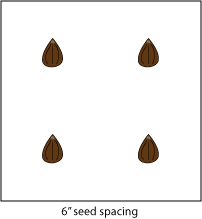
Chard seeds are pods of 3–when planting I only plant one. Once they germinate, thin to 4 per square. You can try transplanting the extras, I’m not sure how well that will work. Each seed pod will produce only one kind, I’m assuming they mix types of seeds in the packet.
My swiss chard has come up in clumps-do I separate them out and do 4 plants per square?
They are also bright lights-will just one seedling produce different colors?
Thanks!
Swiss chard is related to beets, but grown only for the greens.
I would like some information about swiss chard please. is swiss chard the leaves from beets!
thank you